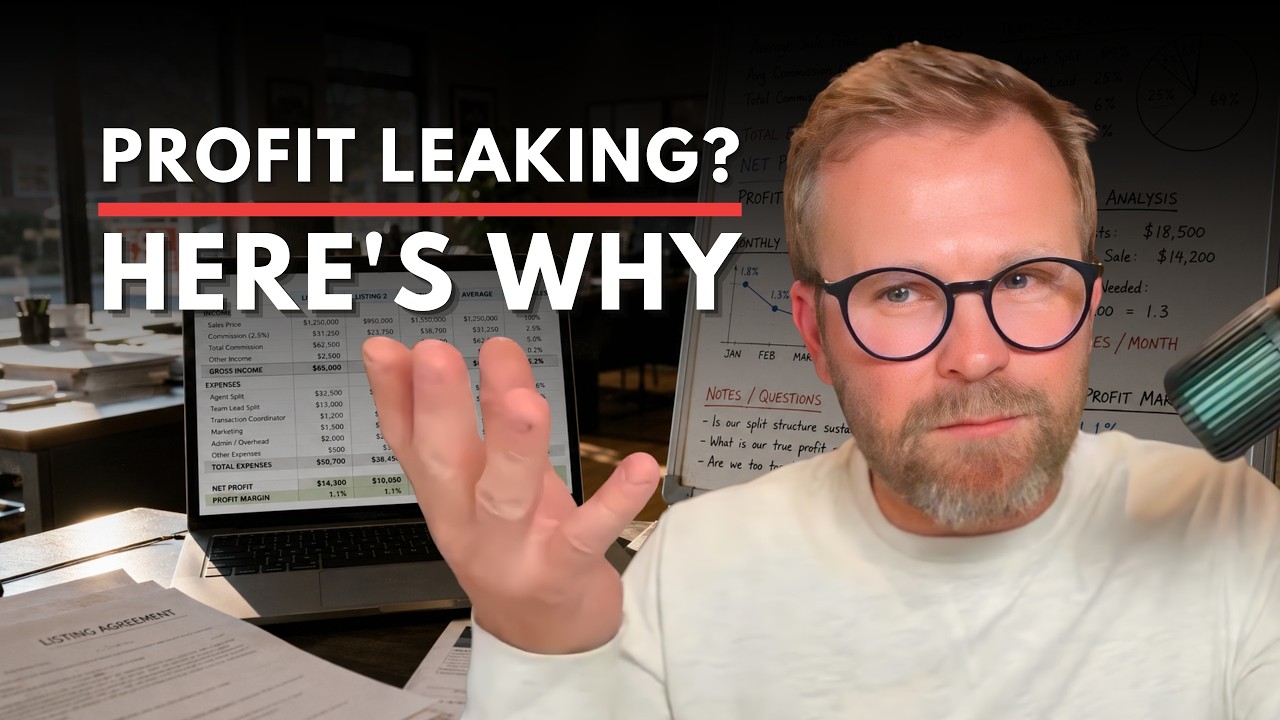
What Your Adjusted Net Profit Is Really Telling You
If your adjusted net profit is negative, it means your personal sales are masking losses and the business cannot stand on its own.

Go Beyond Bookkeeping. Learn how Simple-Numbers will help you get a grip on your real estate business financials. Book a Consultation
Many business owners believe they understand their profit because their financial statements say they are profitable. Revenue looks strong, expenses seem reasonable, and the numbers appear to support growth. But in many cases, those numbers are telling only part of the story. That is where adjusted net profit becomes essential.
Adjusted net profit helps answer a question most owners never stop to ask: If I stopped producing tomorrow, would this business still make money?
Why does adjusted net profit matter? Adjusted net profit removes the owner’s personal production from the equation. It asks whether the business itself is profitable or whether the owner’s sales are quietly carrying the operation. For many teams, especially in real estate, the owner’s production makes the business appear healthier than it really is. Until that production is separated, true profitability remains unclear.
How does paper profit get distorted? On paper, a team may generate $1 million in total revenue and show $150,000 in net profit, which looks like a 15 percent margin. Most owners would feel confident with that number. The problem is that this profit often includes the owner’s production without accounting for the cost to replace that work.
If an agent had handled those deals, the business would have paid a commission or split. When the owner does the deals, that cost never appears on the financials. This missing expense is known as the unrealized cost of sale, and it has a major impact on profitability. Once the same cost of sale is applied to the owner’s production, the profit number starts to change quickly.
The role of the owner’s salary. Owner compensation adds another layer of confusion. Many team leaders pay themselves a salary for tax reasons, which is a common and reasonable practice. From a business standpoint, though, that salary is often profit paid in a different form. When calculating adjusted net profit, that salary gets added back because it is not a true operating expense tied to running the business.
Why do indirect expenses matter? Indirect expenses also affect the numbers. Costs like travel, meals, and vehicle expenses are often run through the business for tax efficiency. While they may be legitimate for tax purposes, they are not always required to operate the company. Including these expenses can make a business appear less profitable on paper while also hiding operational weaknesses when the owner’s production is involved.
What do the adjusted numbers reveal? After accounting for unrealized cost of sale, adding back owner salary, and correcting indirect expenses, profit often drops significantly. In the earlier example, the $150,000 profit falls to $75,000, reducing the margin from 15 percent to 7.5 percent. In some cases, adjusted net profit reveals that the business would actually lose money if the owner stopped producing.
This happens more often than most people realize. The tax lens versus the business lens. Most owners review their financials through a tax lens because that is what their CPA provides. That view is important, but it is incomplete. Tax-focused financials aim to reduce tax liability, not to measure whether a business can operate independently of its owner. Without a business owner lens, personal production can hide weak margins, inefficient structures, and overhead that only works because the owner is still selling.
Why does clarity matter? Adjusted net profit provides a clearer view of business health. It shows whether profit is real, whether the model is sustainable, and whether the business can stand on its own. Understanding this number creates better decision-making, stronger systems, and a clearer path toward stability.
When you understand the real health of your model, you can see what is actually working and what needs to change. That clarity makes it possible to build a business that stays profitable even when you are not the one producing. If you have any questions, schedule a discovery call today, and I can help you figure out if you’re running a profitable team that has healthy numbers.
-
Go Beyond Bookkeeping. Learn how Simple-Numbers will help you get a grip on your real estate business financials. Book a Consultation
-
Free Real Estate Chart of Accounts. Review our recommended P/L accounts for a real estate sales business. Download Now
-
5-Minute Business Budget Tool. Get clear on your annual financials with our simple, and easy to use 5 min budgeting tool. Download Now
-
Free Financial Newsletter. Get our insights on how to understand your money. Subscribe Now